Our
Human Rights StrategyHuman Rights Strategy, View PDF, file size 9.3MBOpens in new window
(Strategy) provides a framework for how we identify, prevent and address human rights risks and impacts across our operations and value chain. It guides our approach to respecting human rights, preventing harm to people, and fostering a culture that embraces diversity, inclusion and equity.
Through the Strategy, we seek to protect and advance the rights of people across our operations and value chain by promoting fair and safe working conditions, responsible purchasing practices and improved outcomes for people who may be vulnerable to harm.
Our approach to managing human rights continues to evolve. We first launched our Human Rights Strategy in 2020 and published a refreshed Strategy in 2024, building on the foundations of our original work. We recognise that respecting human rights is an ongoing process requiring continuous improvement, innovation and collaboration. Our Strategy will be formally reviewed again in 2027 to ensure it continues to reflect evolving risks, stakeholder expectations and leading practice.
Our refreshed Strategy was developed over an extended period in partnership with an external consultant with extensive experience in human rights for business and informed through extensive engagement with internal and external stakeholders. This included team members, suppliers, non-government organisations, union representatives, academics, and representatives from potentially affected stakeholders. Emerging human rights risks, international standards and leading practice were also considered in the development.
Our Strategy is underpinned by four strategic ambition areas, supported by key priorities, measurable targets and action plans to guide implementation across our operations and supply chains through to 2027. Each priority includes defined actions, accountabilities and measures to support implementation and monitor progress. We regularly review implementation, reflect on learnings and adapt our approach to support continuous improvement. Progress against our Strategy is monitored through the Human Rights Steering Committee and reported regularly to the Executive Leadership Team and the Coles Group Board.
As part of refreshing our Strategy, we undertook a salience assessment to identify the human rights issues where our business has the greatest potential to cause, contribute to, or be directly linked to adverse impacts on people. Identifying our salient issues enables us to prioritise where we focus our effort, resources and actions to prevent and address the most significant risks to people across our operations and value chain. We identified our salient human rights issues through:
- mapping our operations and supply chains to identify affected stakeholders and potential impacts on human rights
- engaging with a broad range of stakeholders to understand perspectives on key human rights issues and emerging risks.
- considering emerging global risk factors such as climate change, geopolitical changes and the increased role of technology.
- assessing risks based on the scale, scope and likelihood of potential or actual human rights impacts, consistent with the UN Guiding Principles on Business and Human Rights (UNGP) guidance.
- prioritising issues based on attribution, leverage and existing mitigation or risk controls, followed by a positive impact assessment.
- identifying opportunities to strengthen positive human rights outcomes.
Following this process, eight salient human rights issues were identified across our operations and supply chain including:
| Salient Issue |
Key Focus Areas |
| Appropriate work |
Support appropriate work conditions. |
| Equity and inclusion |
Foster belonging, develop and maintain an inclusive and diverse workplace that is reflective of the communities we serve. |
| Living wage |
Undertake analysis of living wage in key supply chains to identify gaps and opportunities to address systemic underpayment. |
| Severe exploitation |
Reduce risk of severe labour exploitation in our supply chains such as forced labour. |
| Consumer and community health |
Support Australians well-being and access to healthy and affordable food and essential items. |
| Climate social impact |
Address climate related impacts to people and communities by recognising opportunities and mitigating risks. |
| Elevating First Nations |
Increase understanding and recognition of Aboriginal and Torres Strait Islander cultures, histories and knowledge. |
| Grievance and remediation |
Build processes to support workers in safely raising grievances and provide/participate in remediation where appropriate. |
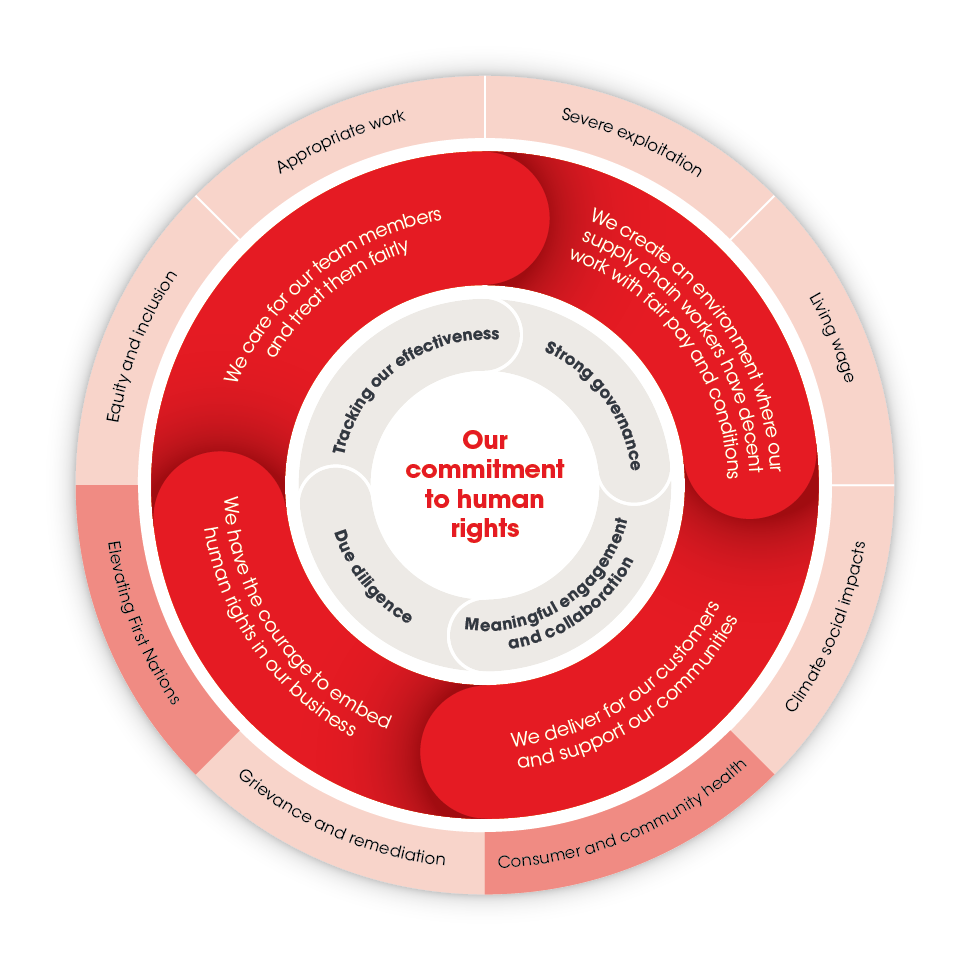
* Where we refer to 'appropriate work', the ILO refer to it as ‘decent work’. Decent work’ is defined by the International Labour Organization as work that is productive, safe, dignified and where worker’s rights are protected.
Our Human Rights Strategy guides our approach to respecting human rights across our operations and value chain. It is supported by governance, policies and programs that help us to identify, prevent and address human rights impacts.
This includes integration with our:
- Ethical Sourcing Program
- Diversity and Inclusion Strategy
- Stretch Reconciliation Action Plan
- Sustainability Strategy
- Group Risk Management Framework
Our operational programs focus on creating safe, inclusive and respectful workplaces for our team members, while our Ethical Sourcing Program supports human rights due diligence across our supply chains.
Our process for identifying and managing enterprise risks, including human rights risks, is set out in our
Group Risk PolicyView PDF, file size 231KB
and Risk Management Standard. Further information is available in our
Corporate Governance StatementView PDF, file size 3.3MB
and
Annual ReportView PDF, file size 16MB.
